
Whale Watching in Costa Rica: Best Seasons in Guanacaste

Updated: 4 days ago
By Mowana Sailing — Private sailing tour from Playa Flamingo

Whale watching in Costa Rica is one of the most memorable wildlife experiences available along the Pacific coast. Each year, humpback whales travel thousands of miles to reach Costa Rica’s warm tropical waters, where they mate, give birth and care for their calves.
The Guanacaste coast offers a beautiful setting for observing marine life in its natural environment. From Playa Flamingo, a private sailing tour takes you away from the busy beaches and into open water, where dolphins, sea turtles, rays and seasonal humpback whales may occasionally appear.
However, these are wild animals moving freely through the Pacific Ocean. No sighting can ever be guaranteed, and every day at sea is different.
When Is the Best Time for Whale Watching in Costa Rica?
Costa Rica is unusual because humpback whales migrate to its Pacific coast from both the Northern and Southern Hemispheres.
Whales from northern waters generally begin arriving around December. They travel south from areas including California, Canada and the Pacific Northwest to enjoy the warmer waters of Central America.
Another population travels north from the Southern Hemisphere, reaching Costa Rican waters from approximately July onward.
This creates two principal periods for whale activity:
December through March or April for whales arriving from the north
July through October or November for whales arriving from the south
The exact timing varies from year to year. Ocean conditions, currents, weather and migration patterns all influence where the whales travel.
Although Costa Rica has one of the world’s longest overall whale-watching seasons, sightings are not equally distributed along the entire Pacific coast. The southern Pacific region is especially famous for humpback whales, but the Guanacaste coast is also visited by whales during their migrations.
Whale Watching in Guanacaste
Guanacaste is known for its long Pacific coastline, secluded bays, rocky islands and rich marine environment. The waters around Playa Flamingo provide opportunities to encounter a variety of wildlife throughout the year.
During the whale migration seasons, humpback whales may travel through the open waters off the Guanacaste coast. They can sometimes be seen surfacing to breathe, lifting their tails before diving or swimming alongside their calves.
The first indication of a whale is often its blow: a visible cloud of air and water rising above the ocean’s surface. On other occasions, a dark back or tail may appear between the waves.
A sighting can last only a few seconds, which makes the experience even more special. The Pacific is vast, and finding a whale depends on being in the right place at the right moment.
What Types of Whales Can You See?
The humpback whale is the species most commonly associated with whale watching in Costa Rica.
Humpback whales are known for their long pectoral fins, powerful tails and occasional acrobatic behavior. Adults can reach an impressive size, yet they move through the water with remarkable grace.
Costa Rica’s warm coastal waters provide an important environment for breeding and raising calves. Mothers may be seen swimming with their young, helping them develop the strength required for their long return migration.
Other whale species occasionally travel through the Eastern Tropical Pacific, but encounters are much less predictable. For visitors sailing from Guanacaste, humpback whales remain the most likely large whale species to be observed.
What Can You Expect During a Whale Encounter?
Every whale encounter is different. You may see a whale breathe at the surface before disappearing below the water, or you may be fortunate enough to observe several surfacing movements.
Possible behaviors include:
A visible blow above the surface
The whale’s back appearing between waves
A tail rising before a deep dive
A mother swimming with her calf
Pectoral fins striking the water
A whale jumping partially or completely out of the ocean
Breaching is spectacular, but it is not something visitors should expect during every encounter. Whales spend much of their time below the surface and can remain underwater for several minutes.
Patience is part of whale watching. The quiet moments spent scanning the horizon make the sudden appearance of a whale even more exciting.
Is a Sighting Guaranteed?
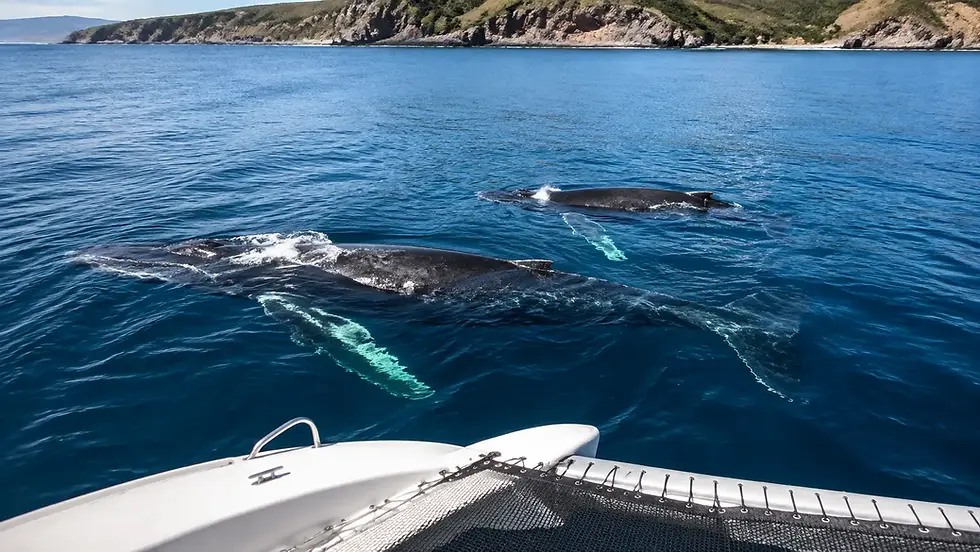
Whale sightings are never guaranteed on a sailing tour.
Humpback whales are wild animals following their natural migration routes. They are not fed, trained or attracted toward boats. Their location can change according to currents, water temperature, weather and the availability of food elsewhere along their route.
Mowana Sailing does not promise a whale encounter. Instead, we offer a private sailing experience during which whales and other marine animals may be encountered naturally.
Even when whales do not appear, the Guanacaste coast offers magnificent scenery, peaceful sailing and opportunities to enjoy snorkeling, paddleboarding, fishing or simply relaxing aboard the trimaran.
Other Marine Wildlife You May Encounter
Whales are not the only animals found along the Guanacaste coast. The Pacific waters around Playa Flamingo are home to a diverse marine ecosystem.
During a sailing tour, you may occasionally encounter:
Spotted or bottlenose dolphins
Sea turtles
Manta rays and spotted eagle rays
Flying fish
Seabirds
Schools of tropical fish
Seasonal humpback whales
Dolphins are present throughout the year and may sometimes approach the boat or swim near the bow. Sea turtles are also frequently observed when they rise to the surface to breathe.
As with whales, all wildlife encounters are natural and unpredictable.
Why Choose a Private Sailing Tour?
A private sailing tour offers a quieter and more personal way to discover the Pacific coast.
Rather than joining a crowded shared excursion, the entire boat is reserved exclusively for your group. This gives you space to relax, observe the ocean and enjoy the experience at your own pace.
Mowana is a fully renovated 33-foot Buccaneer trimaran with a wide deck, comfortable seating and large bow trampolines. The boat welcomes private groups of up to 12 guests.
Depending on the conditions and the interests of your group, the experience can include sailing, snorkeling, paddleboarding, fishing and time at anchor in a peaceful bay.
Captain Jean-Luc has explored the Guanacaste coast for more than 30 years. The sailing route and anchoring location are chosen according to the wind, waves and visibility on the day of the tour.
Respectful Whale Watching
When whales or dolphins appear, it is essential to respect their space.
Boats should never chase marine animals, block their route or separate a mother from her calf. A responsible encounter allows the animals to choose their direction and behavior without pressure.
Our approach is to maintain a respectful distance, avoid sudden changes of direction and let the animals continue their natural journey.
Some encounters are brief, while others last longer because the whales remain in the area. The welfare of the animals must always take priority over obtaining a photograph or approaching more closely.
Visitors can also help by keeping the ocean clean and never throwing plastic, food or other waste into the water.
What Should You Bring?
Conditions on the Pacific Ocean can change throughout the day, so a few simple items will help you remain comfortable:
Reef-safe sunscreen
Sunglasses
A hat with a secure strap
A light long-sleeved shirt
A swimsuit
A towel
A camera or phone
Binoculars, if available
A waterproof case or bag is useful for protecting electronic devices from sea spray.
If you are sensitive to motion, consider taking your preferred seasickness remedy before departure after consulting a healthcare professional.
Morning or Sunset Sailing: Which Is Better?
Both morning and sunset tours can provide opportunities to observe marine wildlife.
Morning conditions are often calmer, making it easier to scan the ocean’s surface. The light is also excellent for viewing the coastline and taking photographs.
A sunset tour combines sailing and wildlife observation with the colors of the Pacific sunset. As the afternoon ends, the sky can turn orange, pink and red above the Guanacaste coastline.
Wildlife follows its own rhythm, however, so no departure time can guarantee a better chance of seeing whales. Weather and sea conditions are more important than the hour alone.
Departing from Playa Flamingo
Mowana’s private sailing tours depart from Playa Flamingo, directly in front of the PLEAMAR restaurant.
Three experiences are available:
Morning half-day tour from 8:30 a.m. to 12:30 p.m.
Sunset half-day tour from 1:30 p.m. until sunset
Full-day tour from 9:30 a.m. until sunset
Every tour is private and reserved exclusively for your group. The same services are included regardless of the number of guests; only the price changes according to the group size.
Drinks, a fresh Costa Rican barbecue prepared aboard, snorkeling equipment, one paddleboard and fishing gear are included.
Experience Whale Watching in Costa Rica Naturally
Whale watching in Costa Rica is not about following a fixed program or forcing an encounter. It is about exploring the Pacific, observing the horizon and allowing nature to surprise you.
During the migration seasons, a distant blow or the sudden appearance of a humpback whale can transform an already beautiful day at sea into an unforgettable memory.
Whether whales appear or not, a private sailing tour from Playa Flamingo offers the freedom to experience Guanacaste from a different perspective—surrounded by the Pacific Ocean, tropical scenery and the people you chose to bring with you.
Every trip is unique, every route depends on the conditions, and every wildlife encounter is a privilege.


Comments